

- No products in the cart.

How we make freddo espresso at our coffee roastery

At our coffee roastery we drink freddo espresso almost every day. It’s the coffee we drink all summer long, and on plenty of winter days too. Here’s how we make it.
In a sentence: a double espresso pulled from 18 grams of ground coffee in the machine, yielding around 36 grams of coffee in 25 to 32 seconds. Two ice cubes in a stainless steel shaker with a strainer top. Frothing on a double-disc Greek frappé mixer for 30 to 50 seconds. Pour into a tall 300 ml glass that already holds three more ice cubes. No water to dilute, no milk.
One thing to keep in mind. This isn’t the only way to make a freddo espresso, and we’re not saying it’s the right way for everyone. It’s our way. We’re sharing it so you can make at home the same recipe we drink here. From there on, play with the ratios and find what works for you.
Below you’ll see step by step what you need, how the coffee falls from the machine, how many ice cubes you need and what shape, how we froth it on the mixer, and which of our espresso blends we recommend specifically for freddo.
In this article
What freddo espresso is
Freddo espresso is a cold coffee made from a double espresso, a few ice cubes, and a quick froth on a Greek frappé mixer. No milk, no water to dilute. The flavor is bold and clean, and it keeps all the aromas of the espresso, just chilled.
It was born in Greece in the early 2000s, when Greek baristas were looking for ways to serve espresso in the summer without losing its quality on the ice. The answer was simple: a quick spin on a frappé mixer, so the coffee cools fast and forms a layer of crema. Today freddo espresso is one of the most popular cold coffees across the whole country.
A lot of people mix it up with freddo cappuccino or the classic frappé. They’re three different drinks:
| Drink | Coffee base | Milk | Short description |
|---|---|---|---|
| Freddo espresso | Double espresso | None | Ice cubes + stainless shaker + spin on the frappé mixer |
| Freddo cappuccino | Double espresso | Cold milk foam on top | A freddo espresso with a layer of cold milk foam |
| Frappé | Instant coffee | Optional | Instant + water + (optional) sugar + spin on the mixer |
If you’ve tried freddo espresso and didn’t like it, try a freddo cappuccino. If that didn’t do it for you either, maybe frappé suits your palate better. There’s no right or wrong here. They’re three different coffees with three different profiles.
What you need
To make a freddo espresso at home you need a few specific things. We’ll go through them one by one and explain why each one matters.
An espresso machine and a grinder. The obvious bits. Use filtered water in the machine, not tap water. Chlorine and limescale stay in the flavor.
A 250 ml shot pitcher. A small metal jug with a handle on the side, with measurement lines inside that show the grams. The espresso falls from the machine into this. It doesn’t fall directly onto the ice.
A stainless steel shaker with a strainer. A stainless steel vessel where the top lid is half-perforated, half-closed. The ice cubes and the coffee go inside it. We use stainless because you can feel with your hand when it has chilled, and that’s the signal the coffee is ready.
A double-disc Greek frappé mixer. The kind of mixer where the vertical shaft carries two discs: one low at the bottom and one a bit higher up. That way the coffee and the ice cubes get properly mixed without producing more foam than they should.
A 300 ml glass. Tall, like a whiskey glass but twice as tall. Not too narrow. If you want a freddo for the road, a 300 ml plastic cup with a lid and a thin black straw works fine.
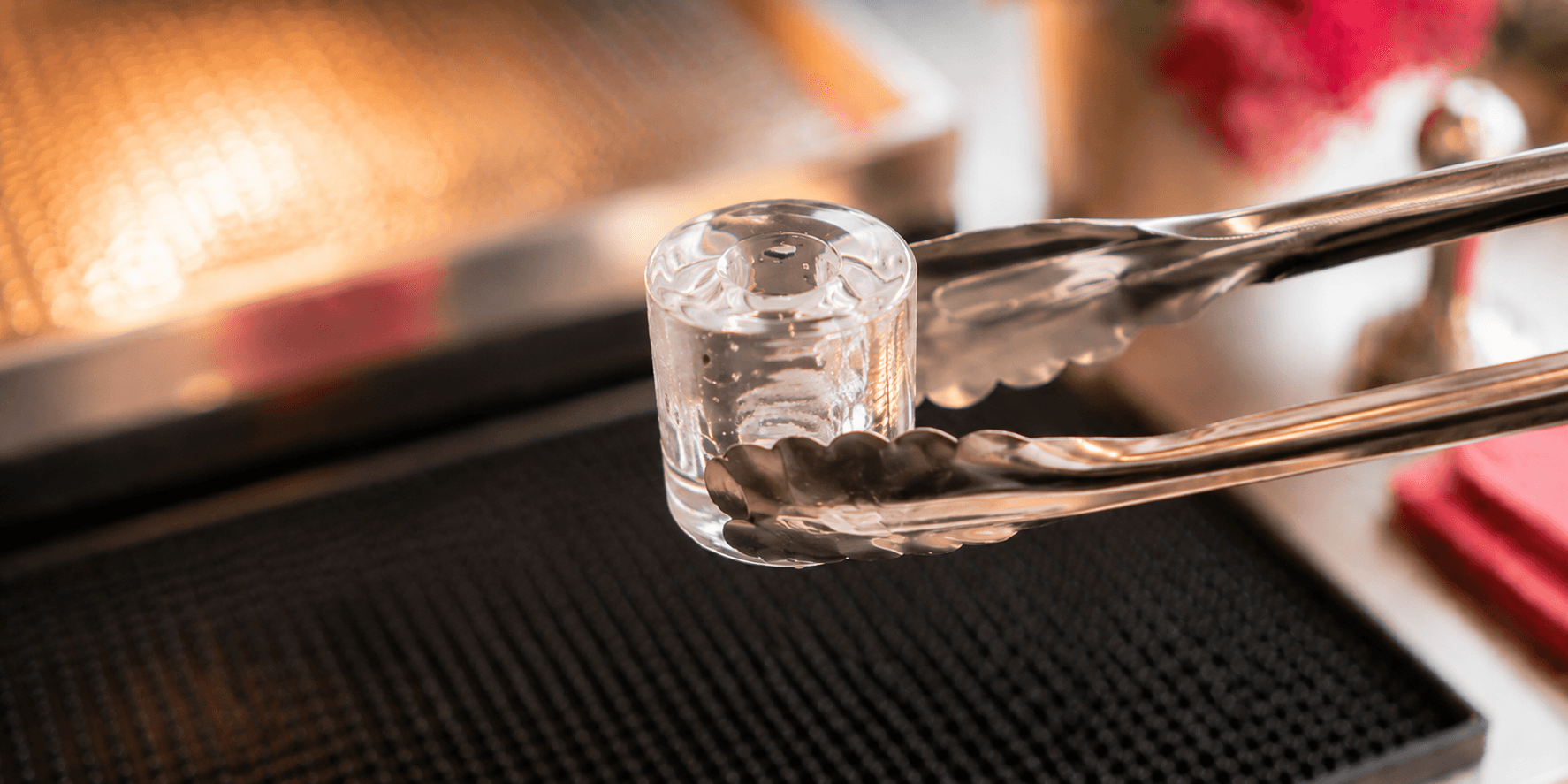
Ice cubes. This is the most important point of the whole recipe, maybe even more important than the mixer. At the roastery we use chunky ice cubes 40 mm tall, with a top diameter of 35 mm and a bottom diameter of 25 mm. Round cubes, like little tumblers, the kind you see in cafes and bars. We don’t make them ourselves: we buy them in ice bags at the supermarket or at the corner mini-market.
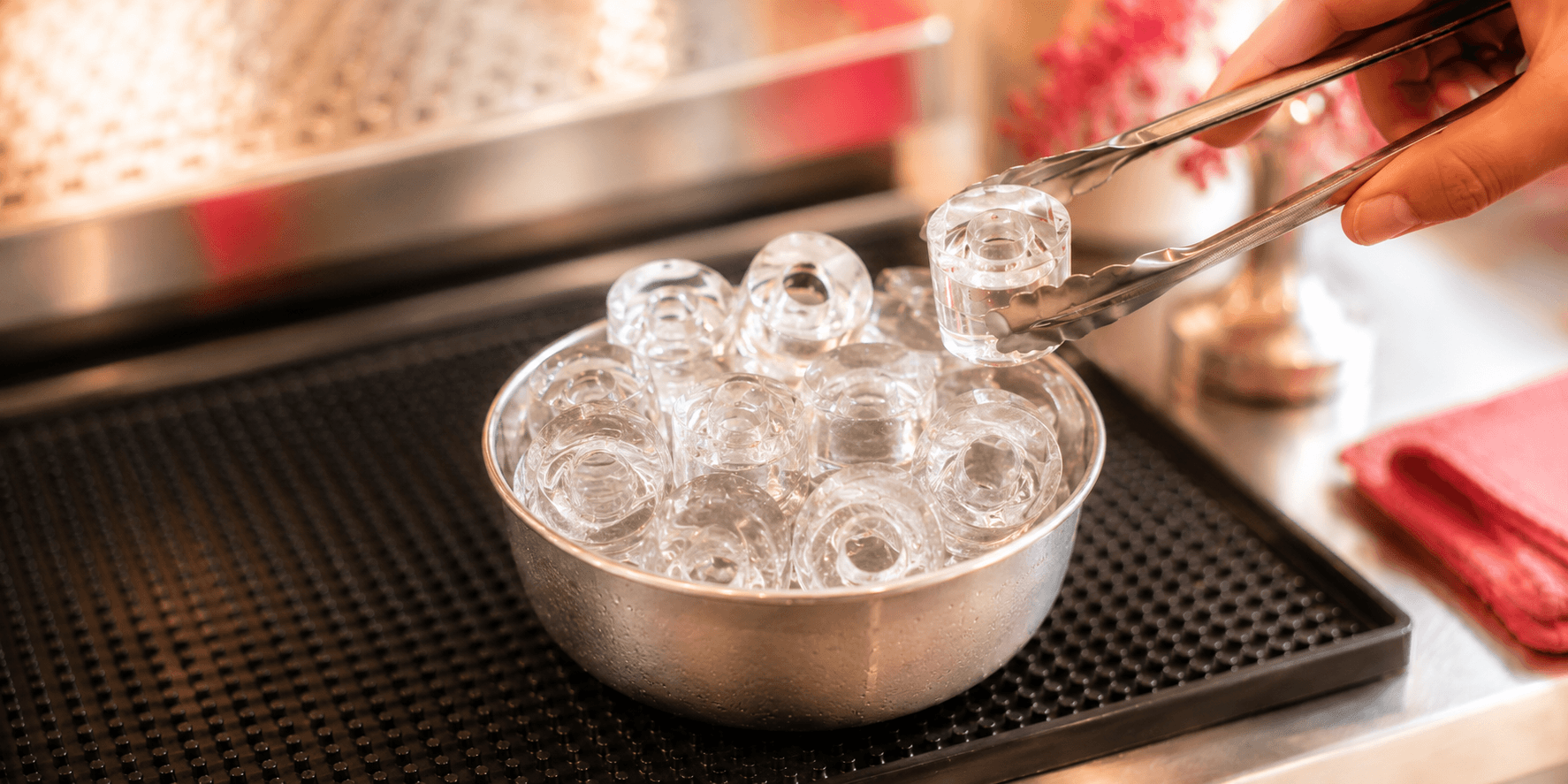
Why does it matter so much? Small ice cubes from a home ice tray melt right away in the hot espresso. The coffee gets watery and loses its flavor. No matter how much you spin the mixer, a freddo made with small ice cubes comes out watery and weak. It can’t be fixed.
Our honest take: if you don’t have chunky bagged ice cubes like these, this recipe won’t work for you. Get the right ice first, then start. Filtered water, clean ice cubes, no freezer odors.
Coffee. Here at the roastery we try every one of our espresso blends in freddo: Costa Rica, Ethiopia, Peru, and all the rest. Out of all of them, three sit a little better with us in freddo: Sweet Amber, Honduras, and Guatemala. We’re not saying they’re the best for everyone. That’s just how we prefer them here. Pick the one that suits you.
The step-by-step recipe
Below are our steps, in the order we follow them here at the roastery. It’s not the only correct way, it’s ours. If you find something else works better for you along the way, change it as you like.
Before you start, if you take your coffee with sugar: add the sugar into the shot pitcher BEFORE you pull the espresso, not after. 1 teaspoon for medium-sweet, 2 teaspoons for sweet, or however much suits you. White sugar, brown sugar, stevia, Canderel, whatever you like. The process is the same. As soon as the hot espresso falls onto it, stir quickly with a metal spoon until it dissolves completely. Not plastic. We drink ours unsweetened, so we skip this step.
1. Pull a double espresso
Pull a double espresso: 18 grams of ground coffee in the machine, yielding around 36 grams of coffee in 25 to 32 seconds. If the time falls outside that range, you need to adjust your grind: finer if it pulls too fast, coarser if it pulls too slow.
The coffee falls straight into the shot pitcher.
2. Drop 2 ice cubes into the shaker
Drop two ice cubes into your stainless shaker. Not more, not fewer. Two.
3. Pour the coffee over the ice cubes
Pour all the coffee from the shot pitcher into the shaker, straight onto the two ice cubes. The hot espresso lands on the ice and starts cooling immediately.
4. Froth it on the double-disc mixer
This is the critical step. Take the shaker and:
- First, hold the shaker at a 30 to 45 degree angle, so the mixer’s shaft enters through the open half of the top lid. Start frothing tilted like that, so the discs reach down to the bottom of the shaker.
- Then turn the shaker upright, 90 degrees.
- And finally, move it gently up and down so the coffee mixes through the full height of the shaker.
Total time roughly 30 to 50 seconds. It’s not a strict number. You watch for three signals and stop:
- You feel the stainless shaker turn cold in your hand.
- Foam starts rising inside the shaker.
- You stop just before the foam reaches the holes of the strainer top, so it doesn’t spill out.
5. Drop 3 ice cubes into the final glass
In the tall 300 ml glass you’re serving in, drop 3 more ice cubes. You’ve now used 5 ice cubes in total: 2 in the shaker, 3 in the glass.
6. Pour the coffee from the shaker into the glass
Pour all the coffee from the shaker into the glass, over the 3 ice cubes. Pour relatively quickly, not too slowly. The fast pour produces a little extra foam on the surface as the coffee passes over the ice cubes.
7. Wait 1 to 2 minutes before drinking
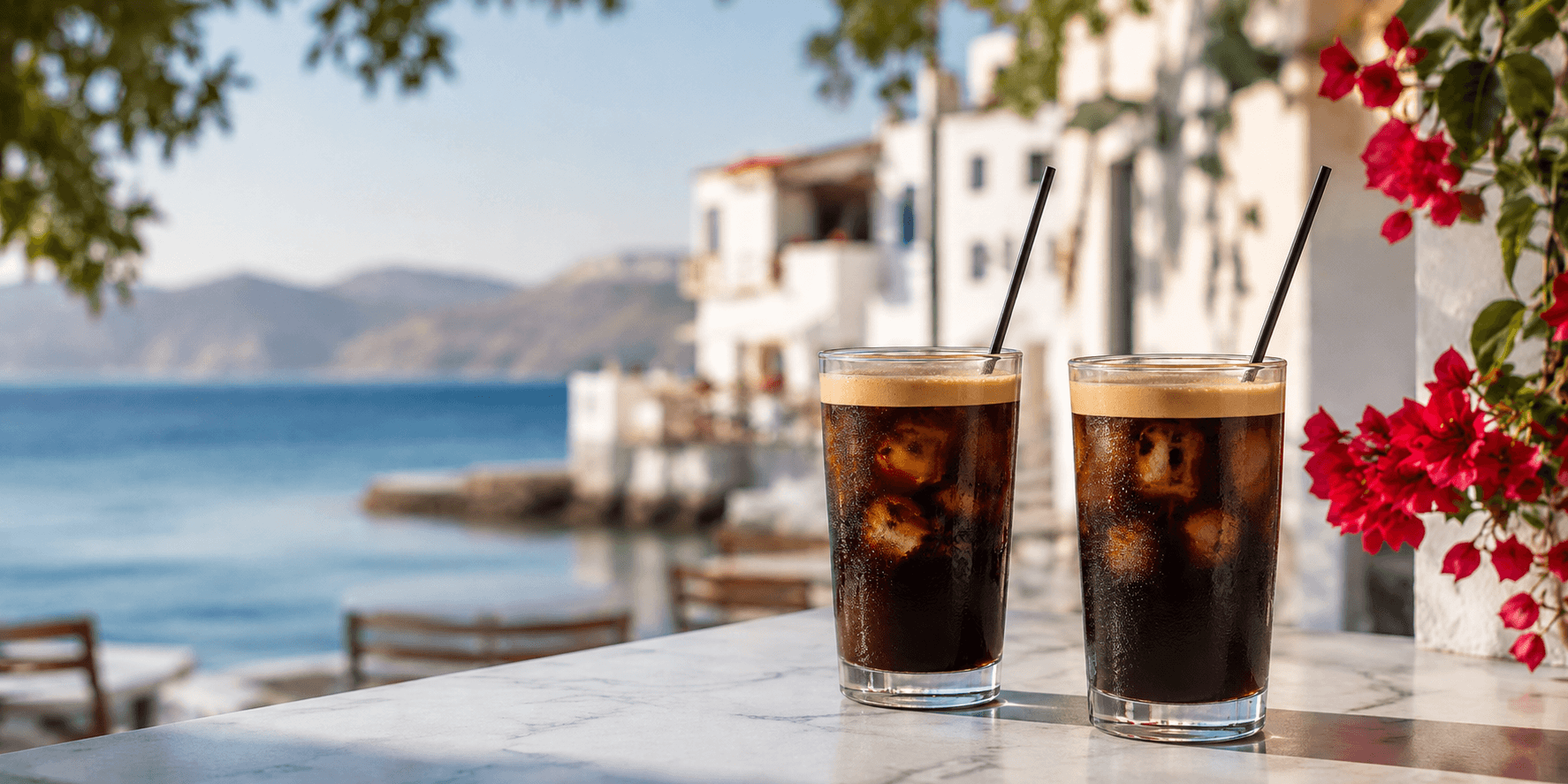
Don’t start drinking it right away. Let your freddo sit for 1 to 2 minutes so the agitation settles and the foam stabilizes. By the end of that time you’ll have two clean layers: the dark coffee at the bottom, and a layer of foam 1.5 to 2 cm tall on top.
How you know you got it right
When your freddo is ready and has rested for the 1 to 2 minutes, look at it carefully. There are three signs everything went well:
- Two clean color layers. At the bottom of the glass you see a dark brown coffee. On top, a clearly defined layer of foam that’s lighter colored, almost the color of caramel or blond.
- Foam 1.5 to 2 cm tall. Not more, not less. That thickness is the sign the froth was right.
- Ice cubes submerged in the coffee. They don’t poke above the surface, they’re not visible up top. They’re all sitting under the coffee.
If one of these isn’t quite right, your freddo isn’t ruined. It’s just telling you something:
- More than 2 cm of foam: you frothed it a touch too much. Next time, stop the mixer a bit earlier, as soon as you see the foam climbing toward the holes of the strainer.
- Almost no foam and the ice cubes stick out above the surface: you frothed it too little. The coffee and the ice cubes didn’t get enough time to mix in the shaker. Next time, froth it longer, until you feel the shaker turn cold in your hand and the foam starts rising.
- The coffee comes out watery and weak: your ice cubes are too small. They melt straight away in the hot espresso and dilute the coffee. Try again with chunky bagged ice cubes, like we said in the equipment section.
Try again. It’s not a mystery, just practice.
Want it on one page? We made a print-ready freddo guide with the recipe, the equipment list with where to buy each piece in Italy, and the troubleshooting bits, all on a single A4. Open the guide →
FAQ
How much coffee do you need for a freddo espresso?
A double espresso needs: 18 grams of ground coffee in the machine, yielding around 36 grams of coffee. That’s enough for a 300 ml glass once you add the 5 ice cubes.
What’s the right grind for freddo espresso?
The same grind you use for a regular hot espresso. You don’t need to change anything on your grinder. If your 36 grams pulls faster than 25 seconds, grind a bit finer. If it takes longer than 32, grind coarser.
Can I make freddo espresso without a Greek frappé mixer?
Not really. The frappé mixer is what chills the coffee and froths it properly. If you don’t have one, you can try a closed cocktail shaker shaken hard by hand for 30 seconds, but the foam won’t be the same. That isn’t our recipe.
Can I use ice cubes from a home ice tray?
No, or at least not for our recipe. Home tray cubes are too small, they melt straight away in the hot espresso, and your freddo comes out watery. Get an ice bag from the supermarket with the big cubes that cafes use.
Why doesn’t my freddo espresso foam up?
Usually because you’re frothing it too little, or because your mixer doesn’t have a double disc. The double disc is what properly mixes the coffee with the ice cubes and produces the foam. Stop when you feel the shaker cold and the foam climbs up to the holes of the strainer.
Which coffee works best for freddo espresso?
At our roastery we prefer three of our espresso blends for freddo: Sweet Amber, Honduras, and Guatemala. Each one has a different flavor profile. It’s not a rule, just a suggestion. Pick the one that suits you.
How long does a freddo espresso last after you make it?
5 to 10 minutes at best. After that the ice cubes melt, the coffee dilutes, and the foam disappears. Freddo isn’t a coffee you prep ahead. Make it the moment you want to drink it.
How many calories does a freddo espresso have?
A plain freddo espresso has about 5 to 10 calories, all from the coffee. Each teaspoon of white sugar adds another 16 to 20 calories. If you drink it unsweetened, it’s one of the lowest-calorie coffees out there.
Let’s make a freddo
This is the recipe we drink here at the roastery. Try it the way we’ve shown you: with the grams, the ice cubes, the seconds. See how it comes out. From there on, change it as you like: a bit more ice, a bit less sugar, a different espresso. That was our recipe. Yours is waiting.
If you want to try the espresso blends we prefer for freddo, take a look at Sweet Amber, Honduras, or Guatemala. All of our espresso blends are in the shop.